Как создать лист персонажа и сохранить внешность в AI-видео
Собираем лист персонажа, чтобы герой не менялся от кадра к кадру, и делаем три AI-ролика. Промты внутри.

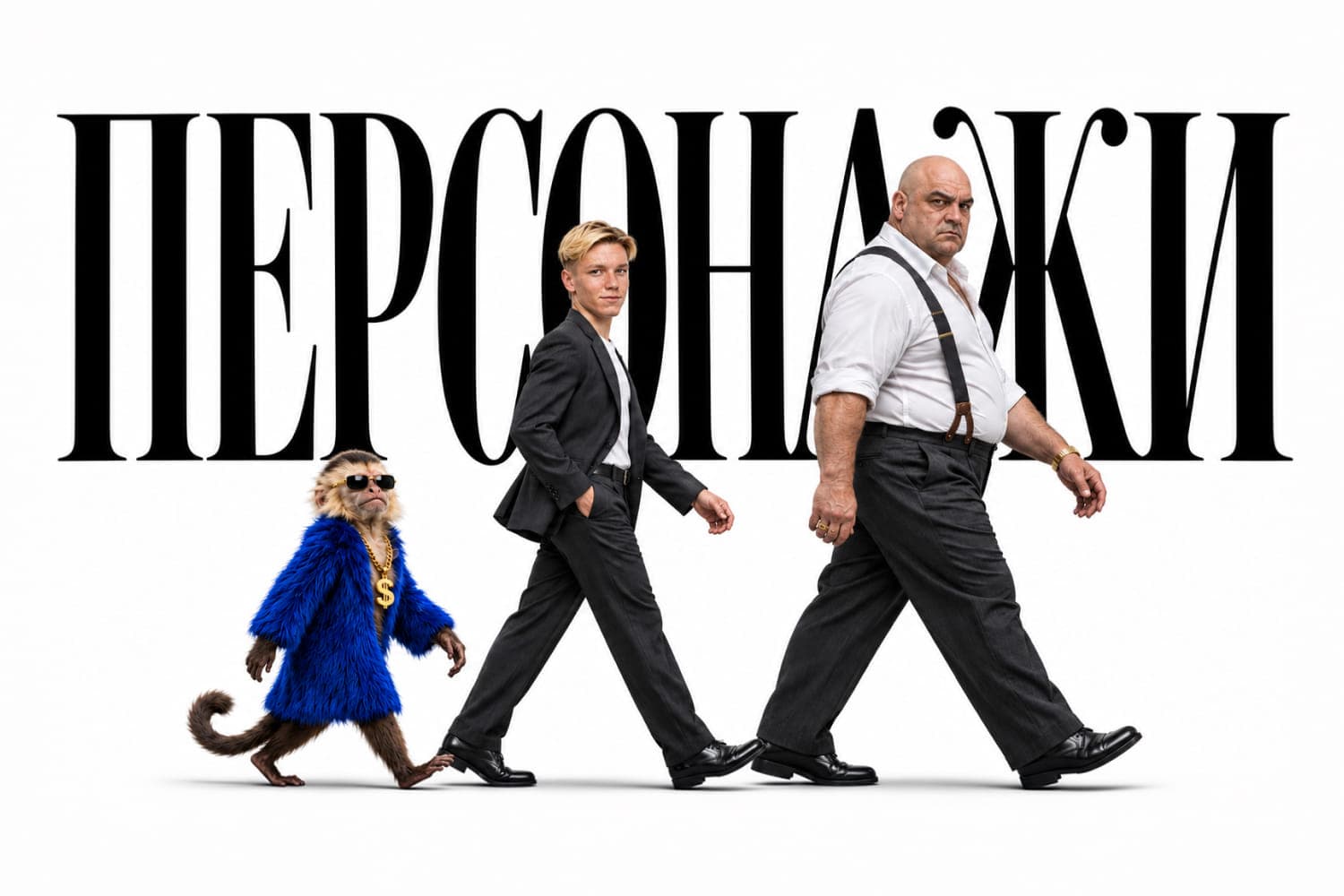
Давай разберём одну из самых бесячих проблем в AI-генерациях: как сделать так, чтобы из кадра в кадр, из генерации в генерацию, у тебя оставался один и тот же персонаж. Потому что, когда в первой сцене ты похож на себя, а во второй уже какой-то другой человек, приходится всё перегенерировать. Видео стоит дорого, и по карману это так-то неплохо бьёт.
В этом разборе я покажу, как подготовить лист персонажа, переодену себя в гонщика, создам босса мафии и приколдесную обезьянку в синей шубе. А потом отправим всех троих в видео. Промты на персонажей, предметы, локации и сами ролики я оставил прямо здесь: забирай, сохраняй к себе и повторяй.
Что подготовить перед генерацией
Если делаешь персонажа из себя, приготовь хорошую фронтальную фотку. Если придумываешь кого-то с нуля — описание внешности и одежды. Картинки можно собрать в ChatGPT или другом генераторе, который умеет работать с референсами. Видео я буду делать в Seedance 2.5 через Higgsfield, а составлять промты мне поможет Claude.
Смотри, какой у нас порядок: сначала собираем лист персонажа, проверяем его и при необходимости поправляем. Потом готовим предметы и локации, расписываем сцены и идём в видеогенерацию. Не спеши сразу тратить кредиты на ролик: если исходники уже кривые, дальше это всё поедет вместе с ними.
Шаг 1. Выбери качественное исходное фото
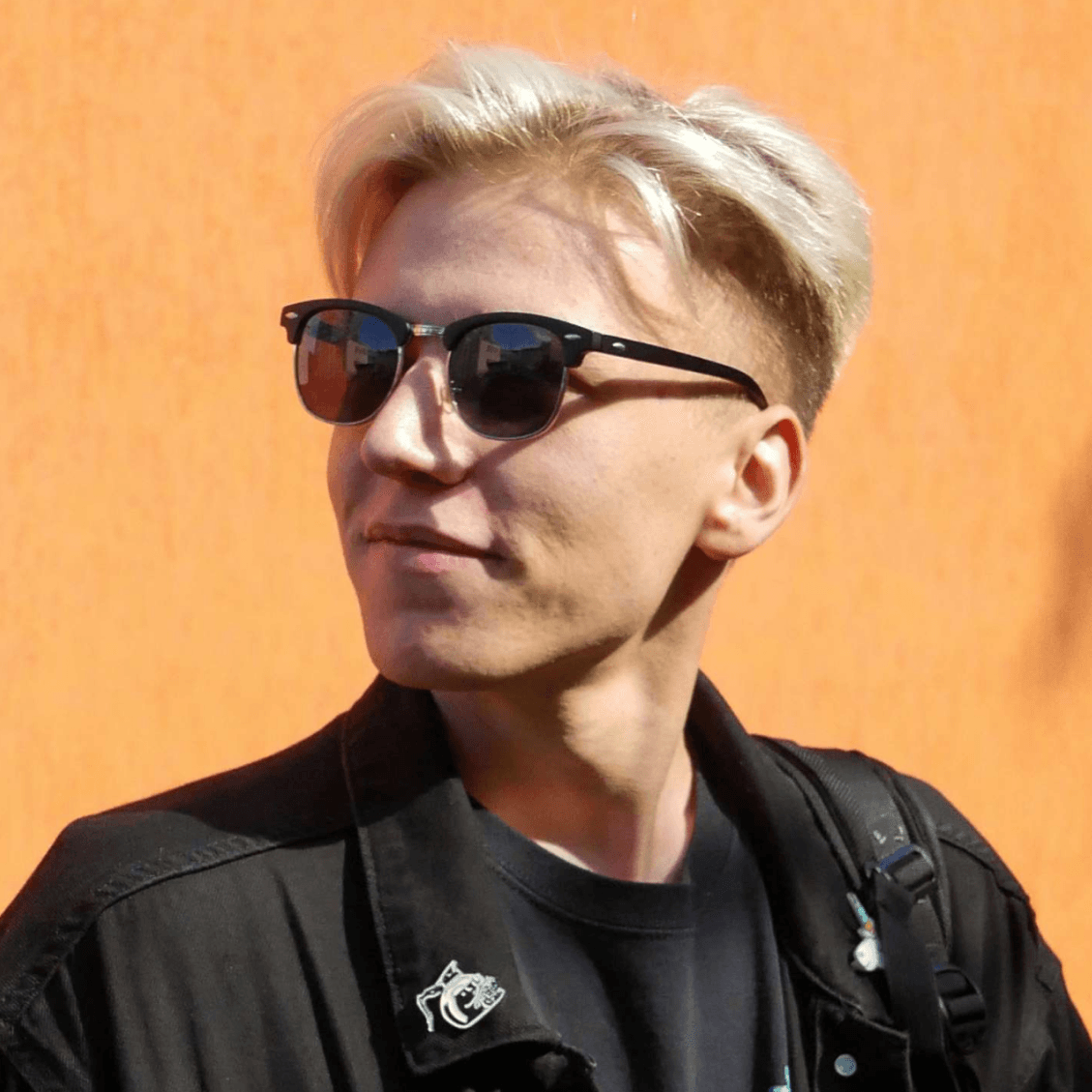
Итак, первое правило клуба листов персонажей: чтобы сделать качественный лист, тебе нужно качественное исходное фото. Без засветов, с ровным светом, где тебя хорошо видно. Не сверху, не снизу, не сбоку — просто анфас, обычное хорошее селфи. В идеале с однотонным фоном, но это уже не обязательно. Главное, чтобы нормально читалось лицо.
Если у тебя на фото размытые глаза или половина лица в тени, нейросети придётся додумывать, что там вообще происходит. Поэтому сначала найди нормальную фотку, а уже потом будем колдовать над промтом. Я показываю на себе, а ты подгружай своё фото и повторяй те же шаги.
Шаг 2. Собери лист из трёх видов
Второе правило клуба: не генерируй миллион разных ракурсов в одном листе. Для нашей задачи мне достаточно трёх видов: крупный портрет, кадр в полный рост спереди и кадр в полный рост сзади. На портрете видно лицо, спереди — телосложение и одежду, сзади — причёску и детали костюма, которые в портрет просто не попадают.
А теперь попробуй поставить себя на место этой AI-машины. Ей дали раскладку из пятидесяти лиц, и на каждом ракурсе человек немного другой. Откуда брать конкретную внешность? Поэтому я не усложняю: один понятный лист, одинаковая одежда и спокойный студийный свет. Весь драматик и синематик оставим для самого ролика.
Промт базового листа по фотографии
Подгрузи своё фронтальное фото как Image 1 и вставь промт ниже. Сначала получаем нормальный базовый лист, с которым уже можно работать дальше.
Используй промт
Create a professional three-view character reference sheet for video and AI production, based on the attached Image 1. Reference and identity: Image 1 is the only identity and appearance reference. If it contains multiple people or characters, use the most visually prominent one without combining features from different subjects. Preserve all clearly visible identity-defining features: facial structure and proportions, apparent age, skin tone, eye colour, eyebrows, hairline, hair colour, length, texture, parting and styling, facial hair, body build, and distinguishing marks or accessories. Preserve natural asymmetry and visible imperfections. Do not beautify, idealise, slim, add musculature, age, de-age, or redesign the subject. Take the subject’s appearance and visible wardrobe from Image 1, but replace its pose, framing, background and lighting as specified below. Do not reproduce a temporary colour cast or photographic filter as an intrinsic feature of the subject. Medium: Match the source medium and character design. For a photograph, produce photorealistic studio photography with natural skin texture and no beauty retouching. For an illustration or rendered character, preserve its visual style, stylisation and anatomy without converting it into a real person or adding photographic skin detail. Background and layout: Use a horizontal 16:9 canvas with three clearly separated views arranged left to right on one continuous neutral deep-grey studio backdrop, approximately #3a3a3c. No visible horizon or floor seam, props, panel dividers or decorative frames. Keep even outer margins and balanced spacing without overlap. Left view, widest: A large chest-up front portrait with the entire head, hairstyle, neck and upper chest visible. Face forward with a calm, neutral, closed-mouth expression consistent with the subject’s natural appearance. Direct gaze toward the camera where the eyes are visible. For a photographic source, keep both eyes sharply focused with subtle catchlights. Centre view: A full-body front view in a relaxed neutral A-pose. Stand upright with weight evenly distributed, feet approximately hip-width apart, arms slightly away from the torso, elbows relaxed, and hands open with naturally resting fingers. Include the entire head and both feet with clear margins. Right view: A full-body back view in the same A-pose. Show the back of the hairstyle, garment fit and footwear. Match the centre figure’s body proportions, rendered scale, head height and foot baseline. Keep anatomical left and right consistent between views. Wardrobe and unseen details: Preserve visible garments, colours, materials, fit and accessories consistently across all three views. Preserve existing visible markings or logos without adding new ones. Where clothing, anatomy or the hairstyle is hidden or outside the source frame, make the fewest necessary assumptions and create a plausible, conservative continuation consistent across views. Complete unseen clothing with simple matching basics and understated footwear. Do not invent hidden tattoos, jewellery, decorative details or identifying marks. Do not treat inferred height, anatomy or hidden details as exact reconstructions. Lighting and clarity: Use soft, even, neutral studio lighting with a large diffused key slightly to the front-left and gentle fill from the right. Keep lighting and colour treatment consistent across all views, adapted to the source medium. Use subtle contact shadows where appropriate. For photographs, use natural portrait perspective, neutral white balance, restrained contrast and sufficient depth of field to keep each subject sharp from head to shoes. Priorities and exclusions: Prioritise identity fidelity, source proportions and cross-view consistency over aesthetic polish. Show exactly three depictions of the same subject. No additional people, blended identities, extra or missing limbs, duplicated body parts, added accessories, text, labels, arrows, measurements, watermarks or new logos. No cinematic colour grading. Do not crop the head or feet in either full-body view.
Когда стоит убрать лицо на общем плане
Смотри, на крупном портрете я ещё похож на себя, а в полный рост лицо маленькое, пиксельное и уже поплыло. Давать нейросети два разных варианта моего лица мне вообще не надо. Поэтому плохую голову на дальнем плане я просто закрашиваю, а хороший портрет оставляю.
Делай так: сначала сгенерируй полноценный лист, потом приблизь и посмотри, что получилось. Если на общем плане уже другой человек, закрась только эту область цветом фона в Photoshop или любом удобном редакторе. Костюм и крупный портрет сохраняем. Так мы убираем противоречивый образец лица.
Шаг 3. Переодень персонажа в гонщика
С базовым листом разобрались. Теперь я хочу что-то более прикольное и кинематографичное, поэтому переодеваю себя в гонщика Формулы. За спонсорством Nexfield, конечно же. Для этого беру свой лист, отдельно добавляю логотип и образец синего цвета с буквой n. В промте прямо говорю: меняем только одежду. Лицо, волосы и телосложение оставляем моими.
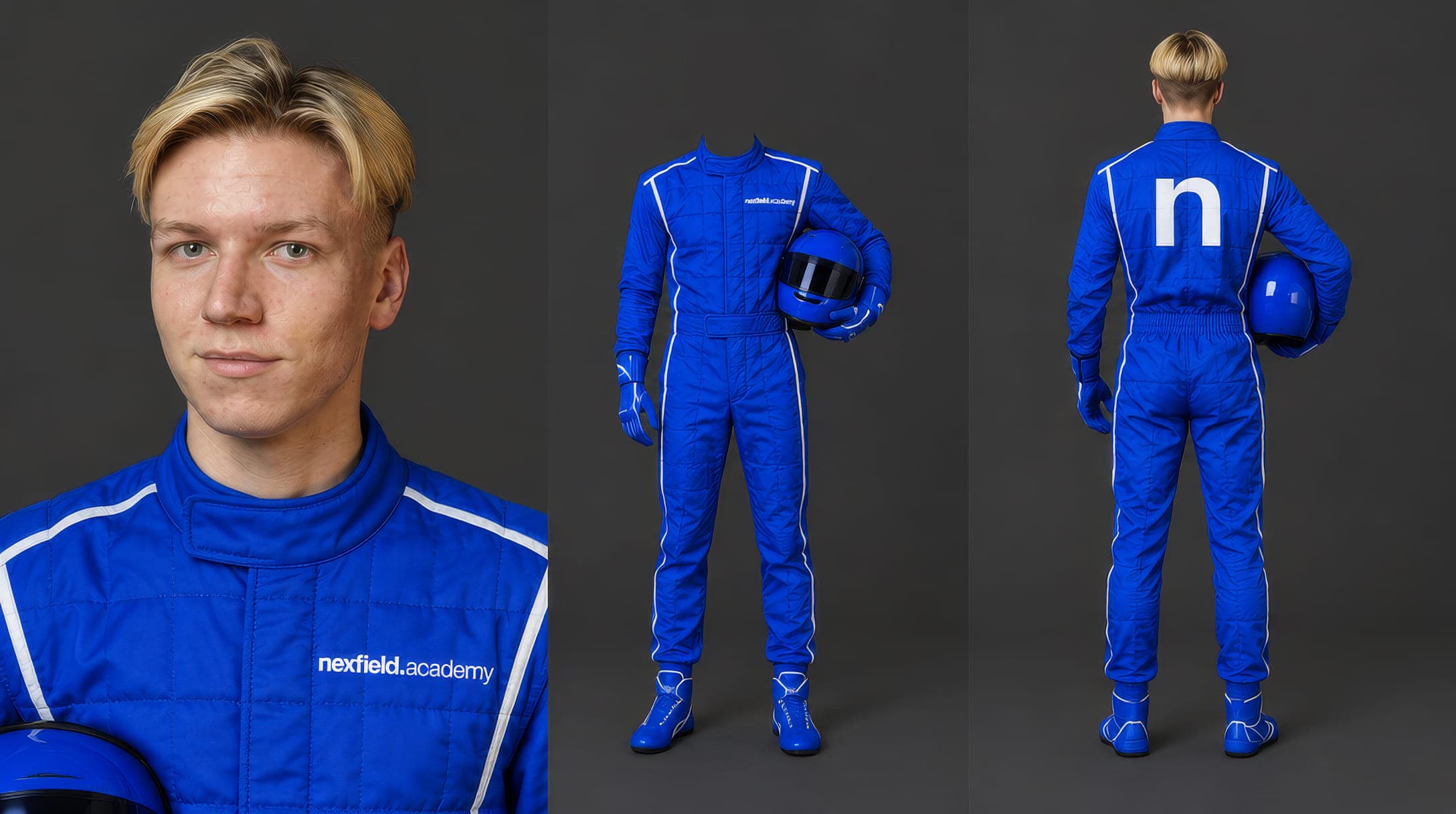
Лист гонщика после подготовки: крупный портрет, костюм спереди с закрытым лицом и вид со спины с белой буквой n.
Промт переодевания в гонщика
Подгружаем по порядку: Image 1 — базовый лист, Image 2 — белый логотип nexfield.academy, Image 3 — белая буква n на синем фоне. Если делаешь под свой проект, подставляй свою айдентику. И обрати внимание на надписи: попросить AI написать логотип правильно можно, но проверить, что он там в итоге написал, всё равно придётся.
Используй промт
A photorealistic three-panel character reference sheet for a video and AI-production workflow: the same young man from Image 1, re-dressed as a Formula racing driver. This is an outfit swap only – the person must stay exactly the same. Image 1: the identity and layout reference – a three-panel character sheet of a young man (chest-up portrait, full-body front, full-body back) on a deep grey studio backdrop. It is the only source of truth for who this person is. Image 2: the chest logo reference – the white lowercase wordmark "nexfield.academy" on a dark background. Use it only for the chest logo. Image 3: the back graphic and colour reference – a bold white lowercase letter "n" on a vivid electric blue background. Use the letter only for the back of the suit, and use this exact blue as the main colour of the suit and helmet. Preserve exactly from Image 1: the face, facial structure and proportions, fair skin tone and texture with visible pores, grey-green eyes, eyebrows, the light blonde hair with darker roots worn in a curtained fringe with short darker sides and back, the slim build, height and body proportions, the calm expression and the head shape. Do not beautify, slim down, age, de-age or restyle him. Do not change the hair colour or haircut. Change only the outfit: – A Formula racing driver suit: a one-piece fire-resistant race suit in the vivid electric blue from Image 3, with subtle white accent piping along the shoulders and sides, stitched quilted panels, a padded mandarin collar, elasticated cuffs and a belt at the waist. Realistic technical fabric with natural folds and correct fit on his slim body. – Matching electric blue racing boots and racing gloves. – A full-face racing helmet in the same electric blue with a dark tinted visor, held tucked under his left arm against his hip. – No sponsor patches, no flags, no numbers, no other logos anywhere on the suit, gloves, boots or helmet. Chest logo: one wordmark on the left chest of the suit, about the size of a palm, rendered in white exactly as in Image 2 – lowercase "nexfield.academy" (n-e-x-f-i-e-l-d . a-c-a-d-e-m-y), with "nexfield." in a bold geometric sans-serif and "academy" in a light weight of the same typeface, on a single line. Render this text exactly once. Back graphic: one large white lowercase letter "n" on the back of the suit, exactly as in Image 3 – the same bold geometric sans-serif shape with a rounded arch and straight vertical stems. It is centred between the shoulder blades and covers most of the upper back, printed flat into the fabric and following its folds naturally. Render this letter exactly once, only on the back. Layout: horizontal landscape composition in a 16:9 aspect ratio, three vertical panels with even margins on one continuous seamless deep grey (#3a3a3c) studio backdrop, no floor line, no props. – Panel 1 (leftmost, widest): chest-up portrait, front view, head, collar and the chest logo in frame, the top of the helmet visible at the lower edge under his arm, eyes looking straight into the camera, sharp focus on the eyes. – Panel 2 (center): full-body front view, head fully visible and identical to panel 1, standing relaxed, helmet tucked under the left arm, right arm hanging naturally, head-to-toe inside the frame including the boots. – Panel 3 (rightmost): full-body back view, same pose seen from behind, showing the back of the haircut, the large white printed "n" on the back fully visible and not covered by the arm or the helmet, the helmet at his side under the arm and the backs of the boots. Lighting and render: the same soft even studio lighting as Image 1 – large diffused key light slightly to the front-left with gentle fill from the right, soft natural shadows, neutral white balance, true-to-life skin tones, identical lighting and colour grading in all three panels. Full-frame 85mm lens look, crisp fabric detail, no heavy retouching. Constraints: the same single person in all three panels, no other people, no duplicated or averaged face. The head must be present and complete in every panel – no headless, cropped or hidden heads. The only graphics are the chest wordmark and the back letter – no other text or symbols anywhere, no labels, no annotations, no arrows, no watermark, no borders between panels, no cinematic colour grading or teal-orange tint.
Шаг 4. Создай вымышленного героя или маскота
Точно так же можно сделать персонажа, которого вообще не существует. Тут нам уже не нужна фотка: описываем, кого хотим получить, генерируем лист и выбираем удачный вариант. Дальше берём именно его во все сцены. Если каждый раз заново придумывать героя по тому же описанию, лицо тоже может каждый раз получаться новым.
Босс мафии
Например, я хочу вот такого босса мафии. Лысый, тяжёлый, недовольный жизнью, в белой рубашке и подтяжках. В промте фиксирую комплекцию, шрам на брови, кольцо и часы, чтобы образ не менялся от ракурса к ракурсу. И здесь я тоже убираю испорченное лицо на дальнем плане: телосложение нам оттуда нужно, а лицо берём с крупного портрета.
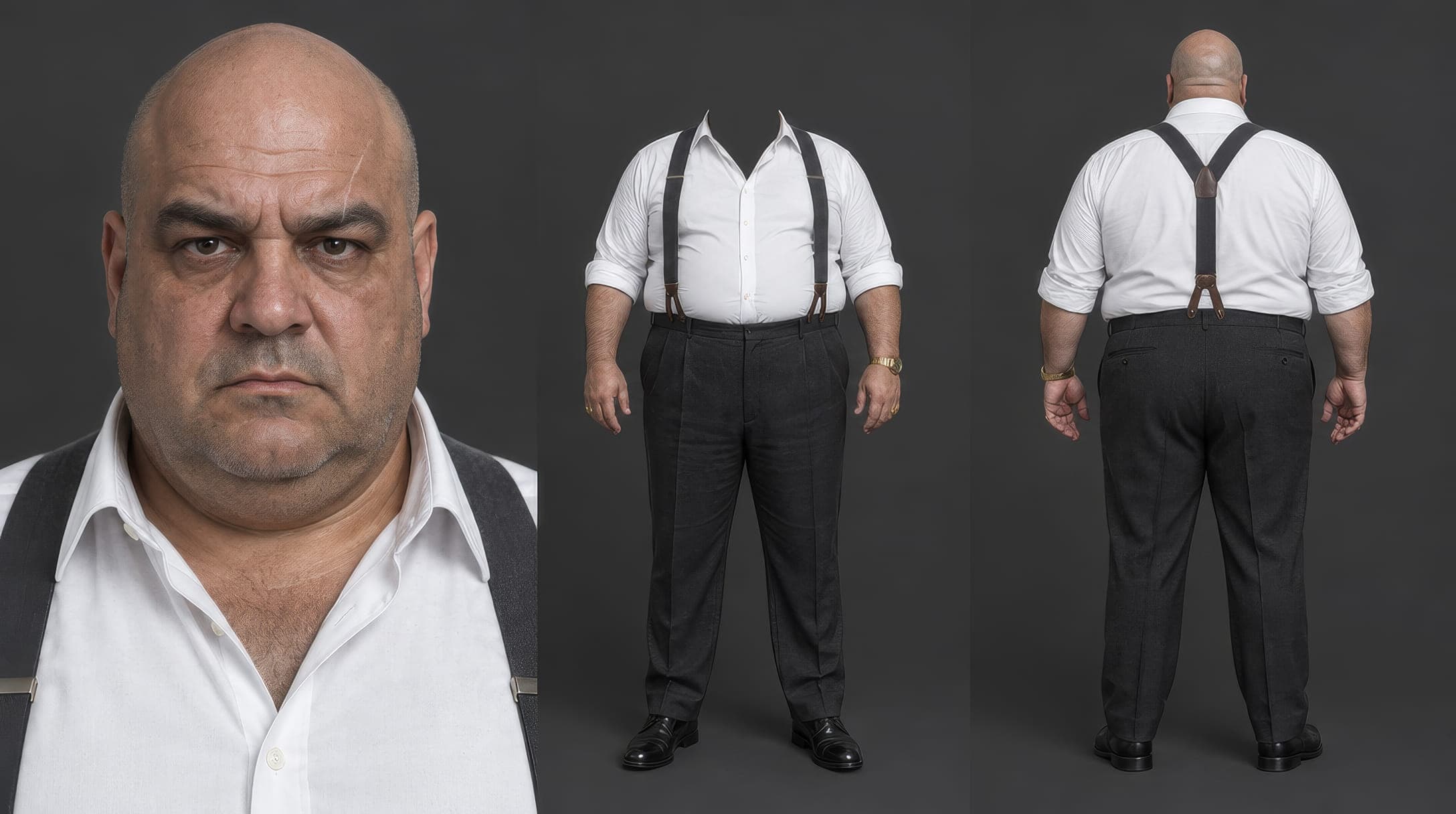
Лист босса мафии: портрет для лица и общие планы для комплекции, рубашки и подтяжек.
Используй промт
A professional character reference sheet for a video and AI-production workflow: an original character, a menacing mafia boss. Show the same single person in all three panels with an identical face, head shape, body build, skin and wardrobe. Photorealistic, editorial studio quality. Character: a heavyset, obese man in his late 50s with a large, round belly that strains against his shirt, broad heavy shoulders, a thick short neck and thick forearms. Completely bald, smoothly shaved head with a natural skin sheen. Fleshy face with heavy jowls, a double chin, a broad nose, deep-set dark eyes under heavy brows and thick hooded eyelids, and faint dark stubble on the jaw. A small old pale scar across the left eyebrow. His expression is cold, calm and intimidating: closed mouth, lips pressed into a flat line, a heavy unblinking stare, slightly lowered chin. Weathered realistic skin with visible pores, fine wrinkles, faint sun spots and subtle imperfections, no beautification and no heavy retouching. Wardrobe: a crisp white cotton dress shirt with the collar open at the top button, sleeves rolled up to the forearms, fabric pulling slightly across the belly. Dark charcoal suspenders (braces) with leather tabs clipped to high-waisted dark charcoal wool trousers with a sharp crease. Polished black leather oxford shoes, a heavy gold signet ring on the right pinky finger and a classic gold wristwatch on the left wrist. The outfit is identical in all three panels – same garments, colours, materials, fit and accessories. Background: one continuous seamless studio backdrop in clean neutral deep grey (#3a3a3c), no gradient banding, no props, no floor line. Layout: horizontal landscape composition in a 16:9 aspect ratio, read left to right, three vertical panels with even margins and consistent panel spacing. Panel 1 (leftmost, widest): chest-up portrait, front view, head and upper chest in frame, eyes looking straight into the camera, tack-sharp focus on the eyes with soft catchlights in both. Panel 2 (center): full-body front view, standing relaxed neutral A-pose, arms slightly away from the body, weight evenly distributed, head-to-toe fully inside the frame including the feet. Panel 3 (rightmost): full-body back view, same standing pose, showing the back of the bald head and thick neck, the suspenders crossing in an X or Y shape on the back, back posture, garment fit and the backs of the shoes. Lighting and render: soft even studio lighting, large diffused key light slightly to the front-left with gentle fill from the right, soft natural shadows under the chin and on the backdrop, no harsh speculars, neutral white balance, true-to-life skin tones, identical lighting and colour grading in all three panels. Full-frame camera with an 85mm lens look, controlled shallow depth of field, crisp detail, high dynamic range. Constraints: the same single person shown three times, no other people, no duplicated or averaged faces – the identity must match in all three panels. Do not slim him down, do not add hair, do not change the scar, stubble, ring or watch between panels. No weapons, no cigars, no props. No text, no labels, no annotations, no arrows, no measurement lines, no watermark, no logos, no borders or frames around the panels, no cinematic colour grading or teal-orange tint. Aspect ratio 16:9
Мистер Манки в синей шубе
А третьего героя я делаю просто потому, что капец обожаю обезьянок. Вот такой у нас будет мистер Манки: синяя шуба, очки, золотая цепь с долларом. Обрати внимание, здесь голову на общем плане я не вырезал. Для этого образа небольшая разница в морде мне не так критична, как чужое лицо на собственной фотке. Но если у твоего маскота есть важные отметины или особая форма морды, их тоже проверяй. Шуба, очки и хвост у нашего бибизяна должны оставаться на месте.
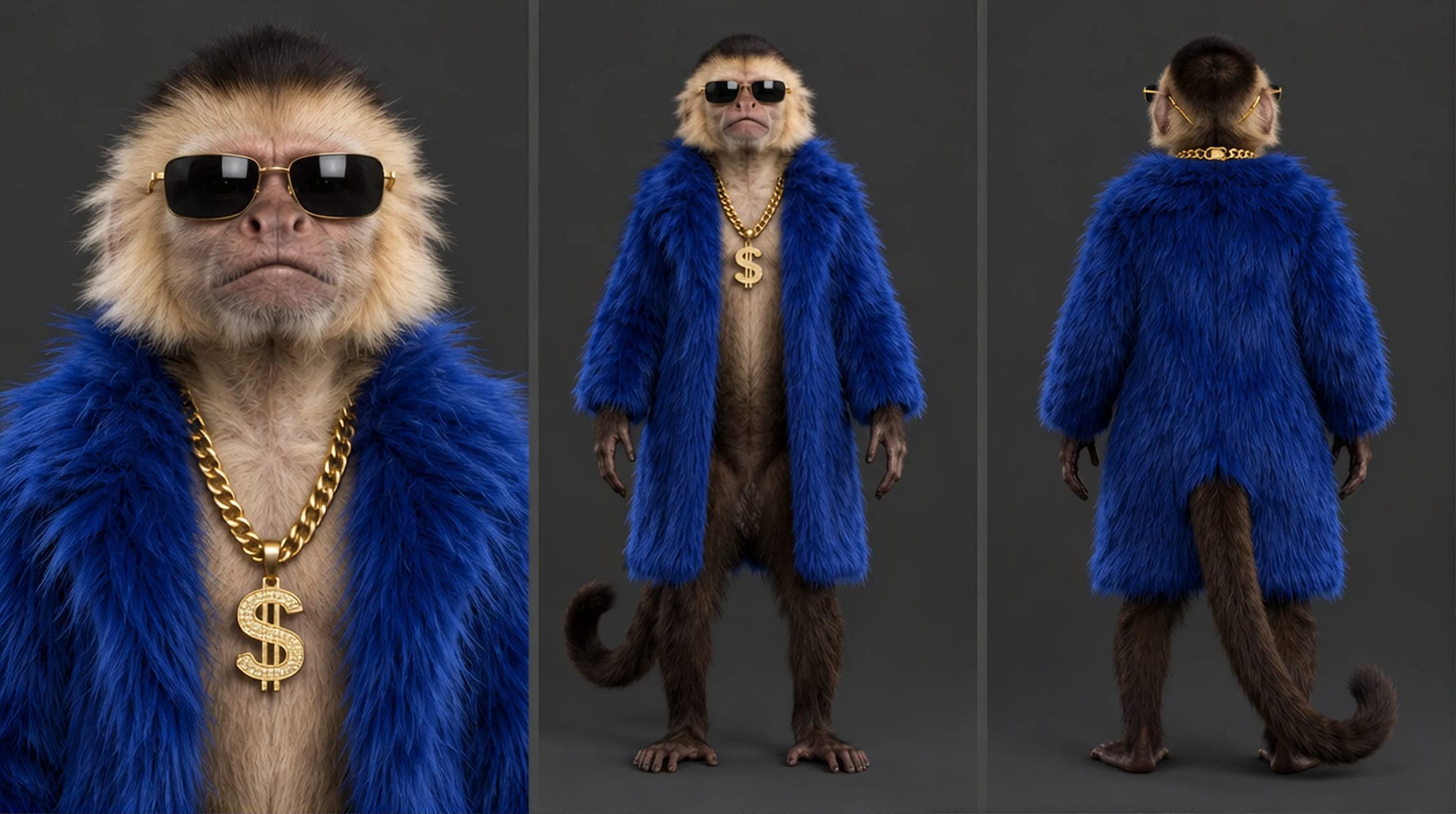
Лист капуцина с одинаковой синей шубой, очками и золотой цепью на всех трёх видах.
Используй промт
A professional character reference sheet for a video and AI-production workflow: a realistic monkey character with a flashy rich-guy attitude. Show the same single animal in all three panels with identical anatomy, face, fur colouring, outfit and accessories. Photorealistic, high-end VFX creature quality, as if photographed in a real studio. Character: a realistic capuchin monkey with true-to-life anatomy and proportions – small rounded head, expressive wrinkled face with natural skin texture, light cream fur around the face and shoulders, dark brown fur on the crown and body, small human-like hands with detailed fingers and fingernails, long prehensile tail. Dense realistic fur with individual strands, natural sheen and slight variation in tone. Standing upright on its hind legs in a natural, balanced posture. The expression is smug and self-assured: closed mouth, slightly raised chin, relaxed shoulders. No cartoon exaggeration, no oversized head or eyes, no human facial features. Wardrobe and accessories: a fluffy faux fur coat in deep vivid royal blue, tailored to the monkey's size, long shaggy fur texture, coat hanging open and reaching down to the knees, the monkey's own fur visible on the chest and arms. Black glossy rectangular sunglasses with a thin gold frame, sitting on the nose with the temples over the ears, with a subtle studio reflection on the lenses. A thick chunky real gold chain around the neck with a large gold dollar sign ($) pendant resting on the chest, catching the light, with realistic weight and metal reflections. The monkey is barefoot. The outfit and accessories are identical in all three panels. Background: one continuous seamless studio backdrop in clean neutral deep grey (#3a3a3c), no gradient banding, no props, no floor line. Layout: horizontal landscape composition in a 16:9 aspect ratio, read left to right, three vertical panels with even margins and consistent panel spacing. Panel 1 (leftmost, widest): chest-up portrait, front view, head, sunglasses, coat collar and the dollar pendant in frame, face turned straight to the camera, sharp focus on the sunglasses and face. Panel 2 (center): full-body front view, standing upright in a relaxed neutral pose, arms slightly away from the body, coat open, head-to-toe fully inside the frame including the feet and tail. Panel 3 (rightmost): full-body back view, same standing pose, showing the back of the head, the sunglasses temples over the ears, the back of the fur coat, the chain clasp at the nape and the tail coming out from under the coat. Lighting and render: soft even studio lighting, large diffused key light slightly to the front-left with gentle fill from the right, soft natural shadows on the backdrop, subtle rim light to separate the fur from the backdrop, neutral white balance, identical lighting and colour grading in all panels. Crisp fur and fabric detail. Constraints: the same single monkey in all panels, identical face, fur, tail, coat, sunglasses and pendant. Keep the head, hands, feet and tail complete. No extra limbs, no other animals, no text, labels, arrows, watermark or panel borders. Horizontal 16:9 aspect ratio.
Шаг 5. Подготовь предметы и локации
Теперь нам нужны элементы, которые будут участвовать в видео. У гонщика это болид и ночная трасса, у босса — бильярдная, у обезьянки — лимузин и красная дорожка. Я готовлю их отдельными картинками и потом подгружаю вместе с листом персонажа. Так у нас есть конкретная машина и конкретная локация, на которые можно сослаться в промте.
Болид на белом фоне
Начинаю с моей ласточки — синего болида с брендингом Nexfield. Подгрузи логотип как Image 1 и вставь промт. Пока делаем машину на белом фоне: нам нужно хорошо видеть её форму, цвет и надписи. На трассу поставим чуть позже.
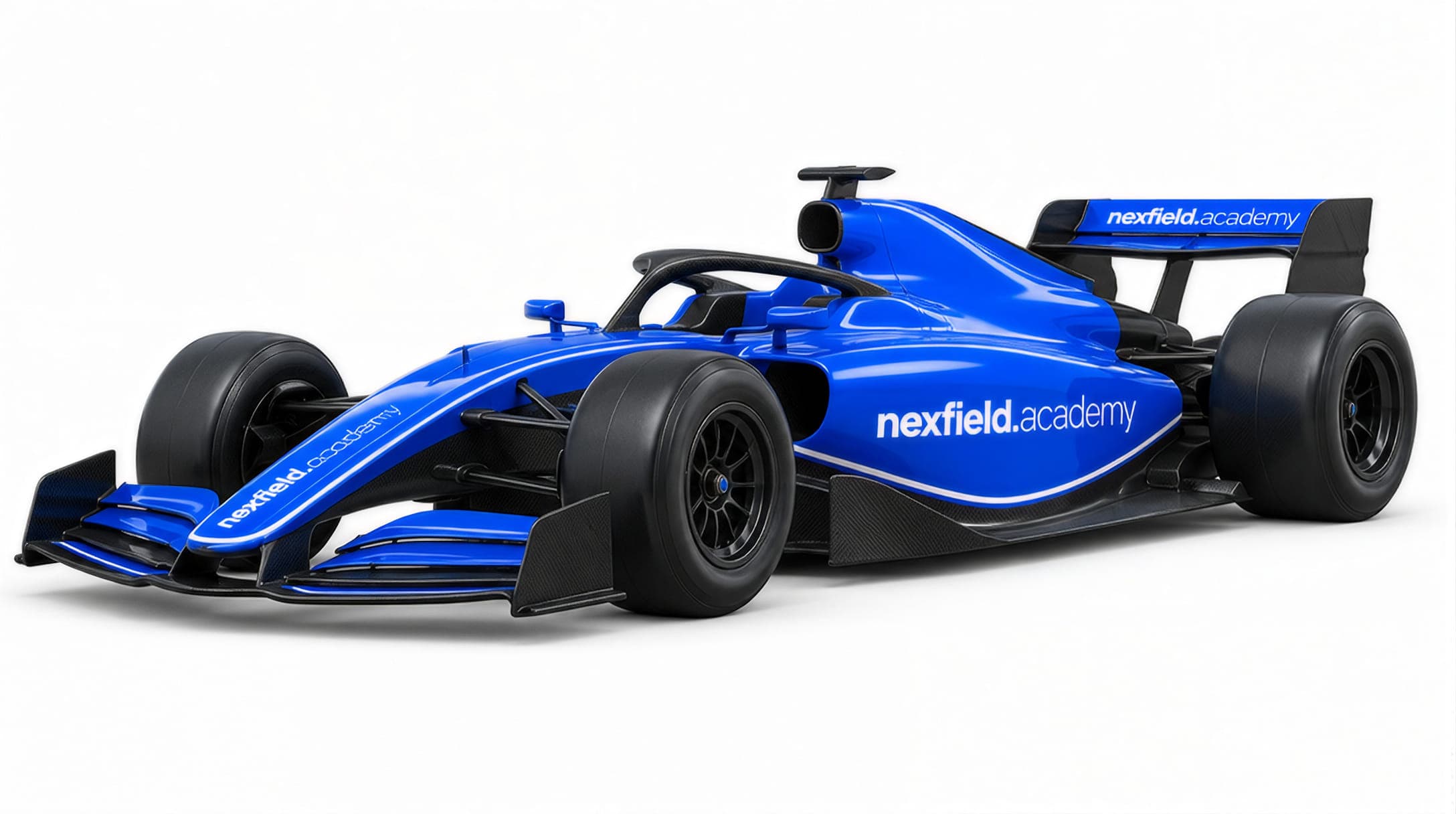
Референс синего болида с логотипом nexfield.academy для дальнейшей генерации гоночной сцены.
Используй промт
A photorealistic studio product shot of an original modern Formula racing car for a brand promo campaign, where Nexfield Academy is the title sponsor. Image 1: the logo reference – the white lowercase wordmark "nexfield.academy" on a dark background. Use it only as the sponsor logo on the car, reproduced exactly: lowercase "nexfield.academy" (n-e-x-f-i-e-l-d . a-c-a-d-e-m-y), "nexfield." in a bold geometric sans-serif and "academy" in a light weight of the same typeface, on a single line. Background: a plain, solid, opaque pure white seamless studio background, no floor line, no horizon, no props. A soft realistic contact shadow under the tyres and a faint diffused shadow beneath the car, so it sits on the ground. Car: an original contemporary open-wheel Formula single-seater, not a replica of any real team's car. Long low chassis with a slim nose, a wide multi-element front wing, sculpted sidepods, a tall engine cover with a shark fin, a large rear wing with flat endplates, a titanium halo over the empty cockpit, and four wide black slick tyres on dark rims with no tyre branding. The livery is vivid electric blue (around #0047FF) with glossy automotive paint and subtle carbon-fibre black on the floor, wing elements and halo, plus thin white accent lines that follow the bodywork. Sponsor branding – the white wordmark from Image 1, and nothing else: – large along both sidepods, the main and most visible placement; – on top of the rear wing main plane, readable from the front three-quarter view; – smaller on the nose, in front of the cockpit. Each placement is printed flat on the paint and follows the curvature of the bodywork, with sharp edges and correct proportions. No other sponsors, no race numbers, no flags, no driver names, no tyre manufacturer marks. Composition and light: front three-quarter view from the left at a slightly low camera height, the whole car fully inside the frame with generous white space around it, centred horizontally. Soft large diffused studio lighting from above and the front-left, clean specular highlights running along the bodywork, crisp reflections in the glossy blue paint, neutral white balance. Full-frame camera with a long lens look, minimal perspective distortion, everything in sharp focus. Horizontal 16:9 aspect ratio. Constraints: one car only, no driver, no people, no pit crew, no track or environment. The wordmark is spelled exactly "nexfield.academy" in every placement – no misspellings, no other text anywhere in the image. No watermark, no borders, no cinematic colour grading, no transparent background.
Ночная гоночная трасса
Болид готов, теперь ставим его на ночную трассу. Здесь Image 1 — мой лист гонщика, Image 2 — машина. Хочу видеть ярко освещённые боксы, ночное небо и кадр со стороны трибун. В этом варианте асфальт сухой, поэтому в видеопромте ниже я тоже оставляю сухую трассу, чтобы условия не спорили друг с другом.
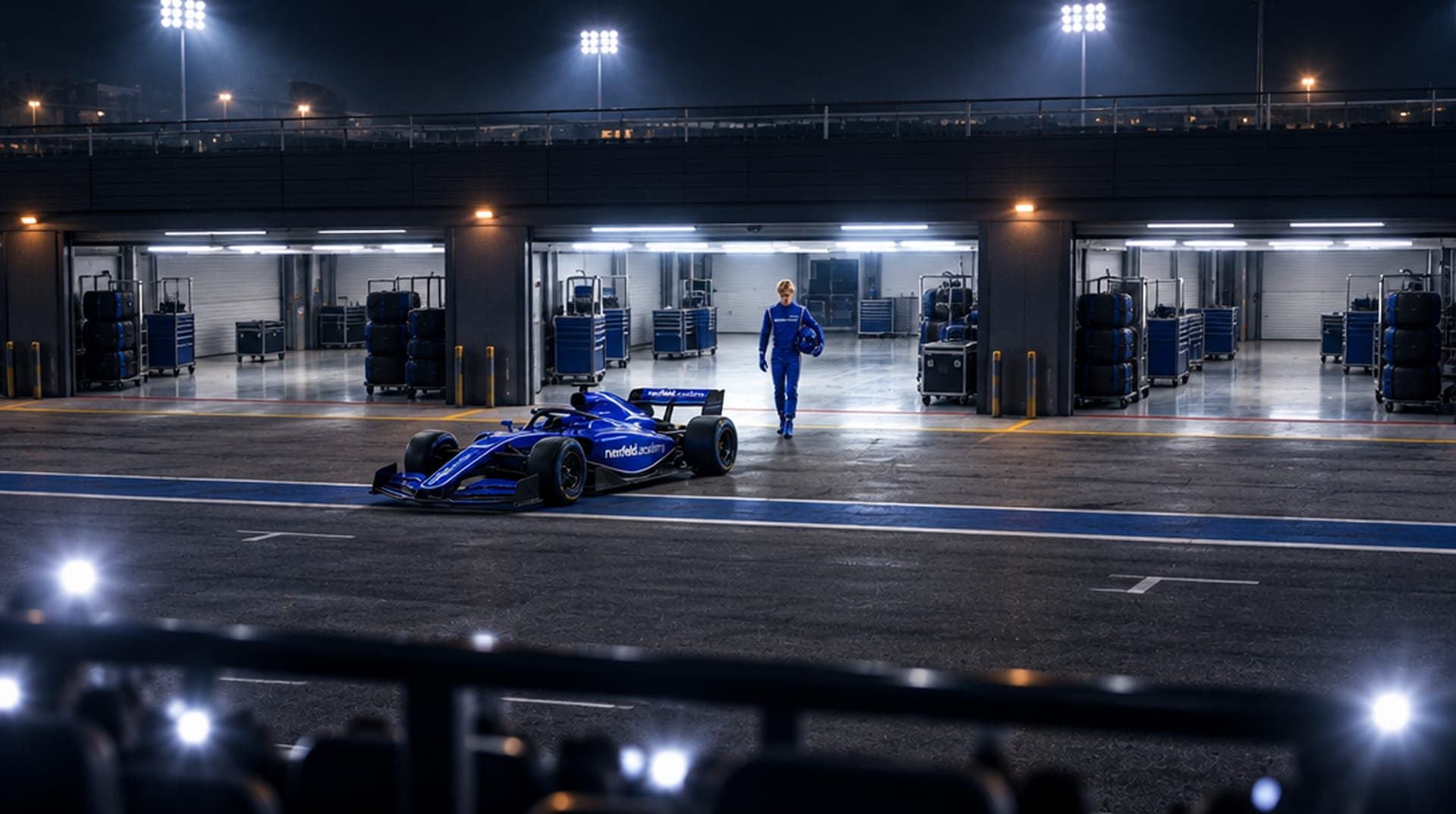
Ночная пит-лейн со стороны трибун: гаражи, болид и гонщик в одном окружении.
Используй промт
A photorealistic cinematic film still from a racing drama at night, shot from the grandstand side of the circuit looking back at the pit garages. Image 1: the racing driver character, reference for identity, face and suit. Image 2: the race car, reference for the car design and livery. The camera is placed high in the grandstand opposite the pits, looking slightly down across the dry main straight and the pit wall toward a long row of brightly lit open pit boxes that run across the frame. In the immediate foreground, the dark blurred edge of the grandstand railing and a few out-of-focus seat backs frame the bottom of the shot, with several bright white camera flashes going off near the lens as soft flares, as if from spectators just outside the frame. In the centre of the frame, one pit box is lit with cold white overhead floodlights. The blue car from image 2 is parked nose-out on the pit lane right in front of it. Keep the car's exact shape, glossy royal-blue livery with black carbon-fibre parts, white pinstripes and the white "nexfield.academy" lettering (spelled n-e-x-f-i-e-l-d . a-c-a-d-e-m-y) on the sidepod and rear wing; do not redesign it. The character from image 1 is walking out of that pit box toward the car, mid-stride, full body visible from head to feet, small in the frame but clearly readable, backlit by the garage lights with a bright rim of light on his hair and shoulders. Keep exactly: his face and features, short blond hair with a middle part, the royal-blue quilted racing suit with thin white piping and the white "nexfield.academy" lettering on the chest, blue gloves, blue racing boots, and the blue helmet tucked under his left arm. He looks ahead toward the car, not at the camera. Do not redesign the character or the suit. The neighbouring boxes on the left and right are lit, empty and tidy, with tyre stacks in heat blankets and tool trolleys. Above the garages, the dark pit building and the night sky with light haze catching the beams of stadium light towers. Completely dry conditions: no rain, no puddles, no wet reflections, matte dry asphalt with painted white lines and faint rubber marks. High contrast, deep blacks, cool blue-white light with warm orange accents, telephoto compression, shallow depth of field with the foreground railing soft, subtle film grain. Wide 16:9 horizontal frame. No other people in the pit lane, no mechanics, no other text or sponsor logos besides the car livery and the suit lettering, no watermark.
Бильярдная для босса
Как по мне, нашему боссу отлично подойдёт вайб тёмной бильярдной, где решаются какие-то мутные делишки. Зелёный стол, низкая лампа, дым, красный неон на фоне — вот сюда его и отправим. Саму локацию сначала генерируем без людей: персонажа добавим уже на этапе видео.
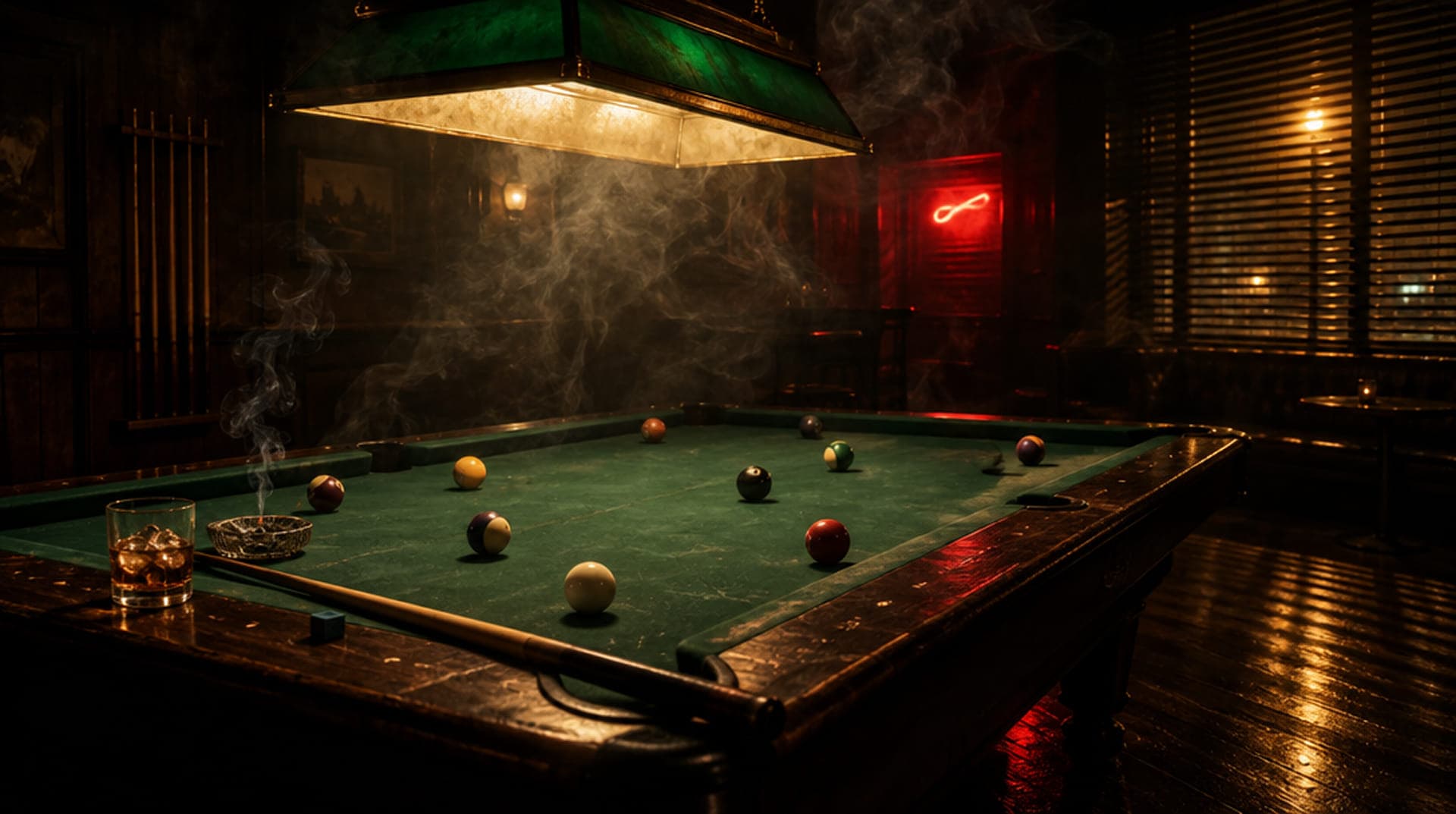
Референс бильярдной с зелёным столом, тёплым светом лампы и красным неоном.
Используй промт
A photorealistic cinematic film still used as a location shot for a neo-noir thriller, showing an empty, smoky billiard hall late at night with no people in the frame. A single pool table with worn green felt sits in the centre, lit from directly above by a low-hanging rectangular brass lamp with a green glass shade, which throws a hard pool of warm light onto the table while everything around it falls into deep shadow. Billiard balls are scattered mid-game across the felt, a cue rests diagonally across the table edge, a chalk cube and a half-empty glass of whiskey with melting ice stand on the wooden rail, and an ashtray holds a still-smoking cigarette. Thick layers of cigarette smoke drift through the lamp light, forming visible swirling volumes and light beams. In the dim background: dark wood panelling, a wall rack of cues, a faintly glowing red neon sign reflecting off a scuffed wooden floor, and venetian blinds casting striped shadows from a streetlight outside. The camera sits at table height at a three-quarter angle, slightly low, with the table occupying the lower two-thirds of the frame. Very high contrast, crushed blacks, warm amber and deep green palette with a single red accent, soft film grain. Wide 16:9 horizontal frame. No people, no hands, no readable text on the neon sign, no logos, no watermark.
Красная дорожка для капуцина
Ну а мистер Манки, очевидно, кроме как по красной дорожке лапы свои не носит. Поэтому готовим лимузин, красный ковёр, ограждения и вспышки камер. Пока без самой обезьянки: эта картинка отвечает за окружение, а её внешность мы потом возьмём с листа персонажа.
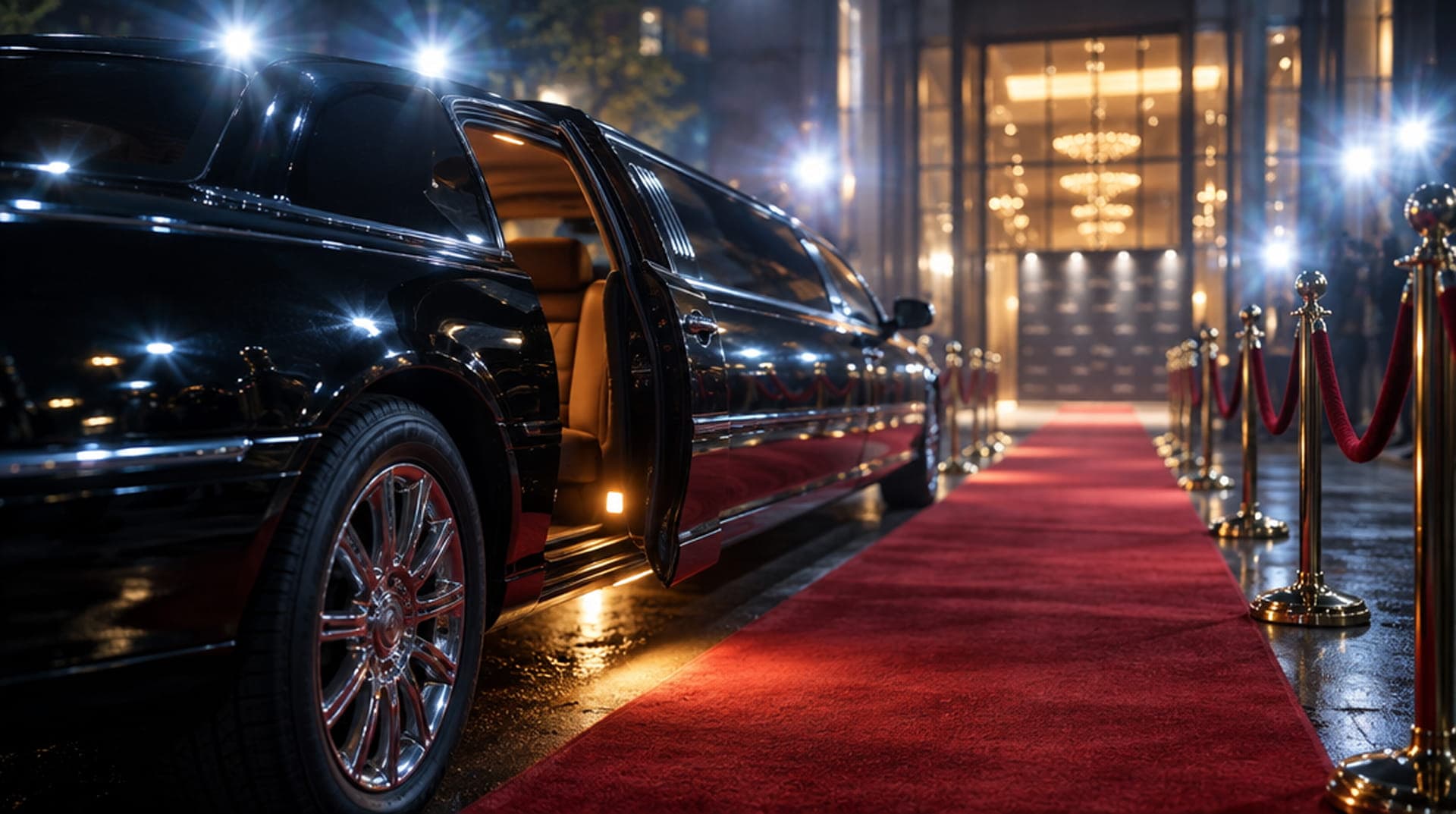
Референс лимузина и красной дорожки для сцены выхода капуцина на премьеру.
Используй промт
A photorealistic cinematic film still used as a location shot for a premiere scene, showing the moment just before a famous guest steps out of a limousine, with no people visible in the frame. A long glossy black stretch limousine is parked at the kerb in the foreground, filling the left and centre of the frame, its rear passenger door already slightly ajar with warm interior light spilling out onto the pavement. A deep red carpet begins right at the door and runs away from the camera toward a brightly lit venue entrance with tall glass doors and a backdrop wall in the background. Polished brass stanchions with thick red velvet ropes line both sides of the carpet. Beyond the ropes, just outside the frame edges, dozens of photographers' flashes are firing at once, rendered as intense bursts of white light, lens flares and bright hotspots reflecting on the limousine's lacquered paint and chrome trim. The camera is low, at knee height near the rear wheel, looking along the car toward the open door and the carpet. Night, cool blue ambient light from the street mixed with warm golden light from the venue and the car interior, light haze in the air, high contrast, shallow depth of field with the venue softly out of focus, subtle film grain. Wide 16:9 horizontal frame. No people, no visible photographers, no hands on the door, no readable text, no brand logos on the car or the backdrop, no watermark.
Шаг 6. Преврати идею в сценарный промт
Дальше я забираю лист персонажа, предметы и локацию и перехожу в Claude. Просто надиктовываю, что хочу увидеть: сколько секунд, какие планы, что герой делает, куда едет камера и что мы слышим. Прошу собрать это в структурированный промт с таймингом и ссылками на элементы. Готовые варианты для всех трёх роликов оставил ниже — можешь сразу брать их.
Только прочитай, что Claude тебе выдал, перед тем как отправлять это на генерацию. Укладываются ли действия в десять секунд? Понятно ли, где какой персонаж? Совпадает ли локация с референсом? Если герой должен открыть дверь, выйти и закрыть её — так и прописываем по порядку. Если действий набралось слишком много и всё ломается, дели сцену на несколько коротких генераций.
Обрати внимание на ссылки в промтах: @image1, @image2, @image3. Подгрузи картинки в Higgsfield и через меню @ привяжи каждое упоминание к нужному изображению. Если у тебя они называются иначе, замени названия везде по тексту. Просто напечатать @image1 мало — за этой ссылкой должен стоять конкретный референс.
Шаг 7. Сгенерируй видео в Higgsfield
Итак, промты готовы, идём в Higgsfield. Открываем Video, выбираем Seedance 2.5 и режим работы с референсами. Подгружаем лист персонажа и все элементы, которые относятся именно к этому ролику.
Ставим десять секунд и широкий формат 16:9. Для теста я выбираю Draft, если он доступен: сначала смотрим, работает ли вообще наша идея, а потом идём в финальное качество. Кредиты впустую нам тратить не надо. Как экономить кредиты на генерации видео, я подробно рассказывал в отдельной статье на сайте Nexfield, рекомендую таки ознакомиться.
Вставляем промт, проверяем привязки и отправляем на генерацию. Потом смотри ролик целиком, а не только первый удачный кадр. Если поехало лицо, проверяй лист и ссылку на персонажа. Если поменялся болид — референс машины. Лучше поправлять что-то одно за раз, иначе потом не поймёшь, что именно помогло.
Видео 1. Гонщик выходит из бокса
Начнём со мной в роли гонщика. Здесь @image1 — мой лист, @image2 — болид на белом фоне, @image3 — ночная трасса со стороны трибун. Хочу драматичный крупный план лица, затем кулак, выход из бокса и приветствие трибун. Вид изнутри гаража описываю словами, а для общего плана ссылаюсь на готовую картинку трассы.
Используй промт
A cinematic, dramatic 10-second sequence of a racing driver preparing to go out on track, in four shots with hard cuts. @image1 keeps the exact same face, blond hair and blue race suit with the white "n" on the back in every shot. The setting is a pit garage and pit lane at night, as in @image3: dry asphalt, floodlights cutting through mist, packed grandstands. @image2 stands in the pit lane outside the garage, its livery and "nexfield.academy" lettering staying exactly the same. Shot 1 (0–2s): Close-up of @image1's face, framed from the top of his head to the collar of his race suit so the whole face is in frame. The face is heavily darkened, sunk in deep shadow, its contours barely readable; a thin horizontal strip of cold light falls across his eyes, making them the brightest point of the image. He stares straight ahead, focused and still, then slowly narrows his eyes. Very slow push-in toward his face. Shallow depth of field, heavy contrast, film grain. Shot 2 (2–3.5s): Hard cut. Tight close-up on his free gloved hand – the one not holding the helmet – hanging at his side in low light. The fingers slowly curl and clench into a tight fist, the glove leather creasing and stretching. The camera drifts slightly upward along the motion, with a subtle rack focus onto the knuckles. Shot 3 (3.5–6s): Hard cut. A complementary view of the same garage from inside, consistent with @image3: @image1 seen from behind in the dark garage, helmet tucked under his arm, facing the open exit. Beyond him, @image2 glistens on the pit lane and the grandstands glow under the floodlights. The garage ceiling lights switch on row by row, flooding the space with cold white light and throwing sharp reflections across the dry floor – and as they do, he starts walking forward toward the exit with steady, determined steps. The camera follows behind him in a slow dolly push, keeping the white "n" centered in frame. Shot 4 (6–10s): Hard cut. Composition follows @image3: a wide shot from the grandstands, dark railings and blurred phone lights of fans in the foreground. @image1 walks out of the brightly lit garage onto the pit lane, turns toward the stands and raises his hand in a confident wave. Without stopping, he lifts the helmet and pulls it on over his head, then walks the last steps to @image2. Slow lateral tracking move along the railing with a gentle zoom-in, keeping him in focus. Aesthetics: dark moody palette of deep blacks and electric blue with warm orange accent lights, dry asphalt and restrained reflections on painted surfaces, volumetric light through mist, anamorphic cinematic look, high-end motorsport commercial. Audio: low rumbling engines and a distant roaring crowd from the first frame; in Shots 1–2 the sound is muffled, as if heard inside his head, with a tense heartbeat-like pulse; in Shot 3 each row of lights switches on with a heavy electric clunk, his footsteps echo on the dry floor and the sound opens up; in Shot 4 the crowd erupts into a loud cheer as he waves, engines roaring. No music, no dialogue.
Итоговое видео с гонщиком
Видео 2. Босс промахивается в бильярде
Теперь наш босс. Под @image1 привязываем его лист, под @image2 — бильярдную. Сначала крупно кий и белый шар, удар — и ничего не попало. Потом лицо: он хмурится, ему явно не нравится результат. И дальше средний план, он натирает кий мелком и говорит: «Ну давай... твой удар». На результате проверь часы, кольцо и то, как реплика совпала с движением губ.
Используй промт
A 10-second cinematic noir sequence in three shots, set in @image2: dim smoky pool hall, green-shaded lamp hanging low over the table, warm amber light, deep shadows, red neon glow in the background, drifting cigarette smoke. Main character is @image1 – heavy-set bald man with a stern face, white shirt with rolled sleeves, dark suspenders, gold wristwatch. Keep his appearance, outfit and the location exactly consistent across all shots. Moody 35mm film look, shallow depth of field, rich contrast. Shot 1 (0–3s): Extreme low close-up at felt level – the polished cue tip rests a few centimeters behind the white cue ball on the green cloth. The cue draws back slowly, then thrusts forward sharply and strikes the ball with a hard crack. The white ball shoots away across the table, glances off a colored ball at the wrong angle, rebounds off the cushion and rolls to a stop. Nothing drops into a pocket. Camera locked static, then a slight rack focus following the ball. Shot 2 (3–5.5s): Hard cut to a close-up of @image1's face, still frozen in his shooting stance right after the strike – bent low over the pool table, chin just above the cue resting on the bridge hand, lamp light falling hard on his bald head, smoke drifting past. His eyes follow the ball as it misses, then his heavy brows lower and pull together into a deep, irritated frown. He slowly pushes himself up from the table and straightens to standing, the camera tilting up with him to keep his frowning face in frame. Shot 3 (5.5–10s): Hard cut to a medium shot of @image1 standing beside the pool table, holding the cue upright in one hand. With the other hand he twists a small blue chalk cube over the cue tip, slow and deliberate, still frowning. He lifts his eyes toward someone off-screen and says in Russian, in a low, raspy, unhurried voice with a slight pause: "Ну давай... твой удар." Camera static at chest height, subtle handheld breathing. Audio: sharp crack of the cue strike, clack of balls and a soft thud against the cushion, low ambient hum of the bar, quiet creak of the chalk on the cue tip, then his line of dialogue. No music.
Итоговое видео с боссом
Видео 3. Капуцин выходит на красную дорожку
Возвращаемся к нашему бибизяну. @image1 — его лист, @image2 — лимузин с красной дорожкой. Начинаем с доллара на цепи, пока он едет в машине, потом выход под вспышки камер и проход по ковру. В последнем плане у нас ещё и автограф. Посмотри внимательно на руки и передачу ручки: если этот момент ломается, убирай автограф и оставляй спокойный проход с кивком фотографам. Лучи славы он и так получит.
Используй промт
A 10-second cinematic sequence in three scenes with hard cuts. @image1 – the capuchin monkey in a royal-blue fur coat, gold sunglasses and a gold chain with a dollar-sign pendant – looks exactly the same in every scene. Night, luxury premiere mood, high-contrast look, warm gold tones, cool blue camera flashes. Scene 1 (0–3s): Extreme close-up of the gold dollar pendant resting on @image1's blue fur coat as he rides in the back seat of the limousine from @image2. Matte gold, no sparkle or glints on the chain. Soft city lights pass in the background, tan leather interior. Handheld camera with a gentle road vibration, slow tilt up to his chin and sunglasses. Scene 2 (3–6.5s): Reporter's point of view, as if filmed by a nervous photographer in the crowd. Grainy, noisy footage, shaky handheld camera, slightly unstable focus. The black limousine from @image2 pulls up to the red carpet and stops. The rear door opens, @image1 steps out onto the carpet, turns and closes the door behind him with one hand. Bright camera flashes from the crowd light him up, causing brief overexposure in the frame. Scene 3 (6.5–10s): Clean cinematic footage again. @image1 walks along the red carpet toward the camera, the camera slowly moves backward in front of him. The black limousine stays parked on the right side of the frame, door closed, it does not drive away. Gold stanchions and red velvet ropes line the carpet, the glowing entrance behind. From off-screen on the left, a fan's hand reaches into the frame holding a small notepad and a pen. @image1 pauses for a moment, takes the pen, calmly signs the notepad without looking at the fan, hands the pen back and keeps walking. Photographers' flashes continue around him.
Итоговое видео с обезьяной
Шаг 8. Проверь консистентность и подготовь финал
Вот теперь смотрим, ради чего всё затевали: остался ли наш персонаж собой от сцены к сцене? Останови видео на каждом новом плане и сравни с листом. У меня должны остаться мои лицо, волосы и комплекция, у обезьянки — её морда, шерсть и хвост. Потом смотри костюм, аксессуары, логотипы и предметы. И отдельно — руки, надевание шлема, удар кием, дверь лимузина. Там тоже бывает весело.
Если поплыло лицо, вернись к листу: нет ли там второго, кривого варианта? Если костюм стал другим, посмотри, не попросил ли ты сам поменять его в промте. Если исчез предмет, пропиши его в нужном плане. А если нейросеть не вывозит все движения камеры сразу, оставь одно основное. Когда тест тебя устраивает, запускай финал и обязательно пересматривай его тоже.
Частые вопросы
- Нужно ли делать десятки ракурсов?
Я бы начинал с тех трёх видов, которые показал выше. Если для конкретной сцены нужен профиль — добавляй, только проверь, что это всё ещё тот же человек. Огромный лист с разными лицами нам задачу не упрощает. - Обязательно ли закрывать голову на общем плане?
Нет. Я закрасил голову, потому что на общем плане получился уже не я. Если у тебя все ракурсы совпали нормально, оставляй как есть. После любой правки всё равно посмотри, как твоя видеомодель поняла этот референс. - Можно ли гарантировать одно лицо во всех генерациях?
Я бы не обещал тебе, что после одного листа больше никогда ничего не поплывёт. Мы убираем противоречивые исходники и даём AI понятный образец, но каждый результат всё равно смотрим. Для серии роликов бери один и тот же согласованный лист и набор элементов. А слишком сложные сцены разбивай на отдельные планы.
Хочешь прокачаться в AI-видео?
Если хочешь глубже разобраться в видеогенерациях — велкам к нам на обучение в Nexfield Academy. На курсе Создание видео с AI разберём путь от идеи и раскадровки до ролика. А если сейчас больше интересуют картинки, персонажи и визуальные серии, залетай на Создание визуала с AI.
Для начала возьми одного героя и одну локацию, собери лист и повтори короткую сцену. Промты у тебя уже есть. Создавай качественные генерации, не трать кредиты впустую и изучай AI.